Featured in Issue 002
The difference between star wars and star trek is you're an idiot
Just because soemthing takes place in space doesn't make it the same thing, people.
There are certain arguments humanity should have settled by now.
Is a hot dog a sandwich? No.
Does pineapple belong on pizza? I don’t care. Grow up and eat what you like.
Is Die Hard a Christmas movie? Obviously.
And then there’s the granddaddy of nerd arguments:
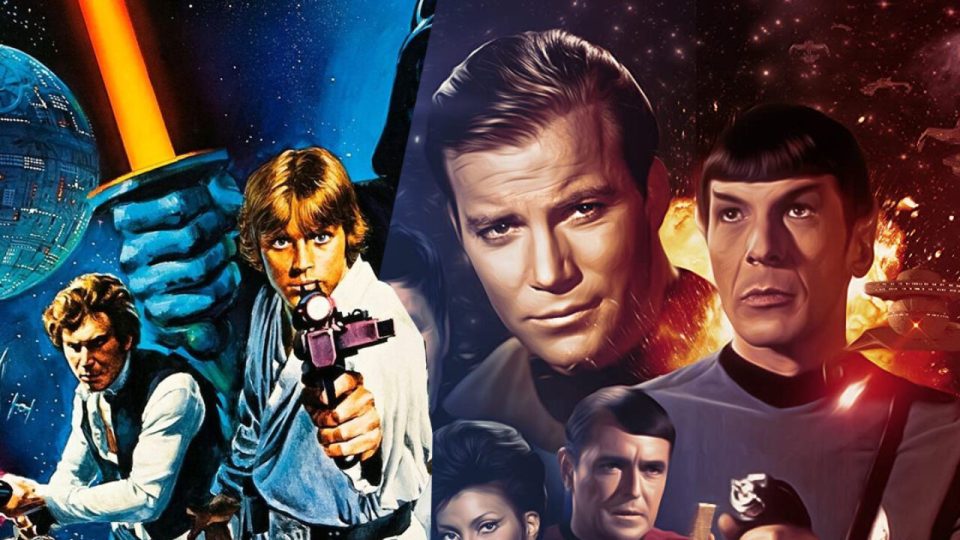
Star Wars vs. Star Trek.
Which one is better?
The answer is simple.
You’re an idiot.
Not because one is secretly superior to the other, but because comparing them makes about as much sense as comparing The Lord of the Rings to Apollo 13 because both contain stars.
Star Trek is science fiction.
Star Wars is fantasy.
It just happens to be fantasy where everybody owns a spaceship.
Star Trek: “What If Science Did Some Weird Shit?”
At its heart, Star Trek is interested in what happens when humanity advances technologically and socially.
Warp drives. Transporters. Artificial intelligence. Genetic engineering. Time travel. Replicators. Holodecks.
The franchise routinely takes some scientific or technological idea, turns the knob until it breaks off, and then asks:
“Okay, what would this do to people?”
Consider the transporter.
Star Trek could simply treat it as a magical device that moves characters from the Enterprise to Planet Forehead-of-the-Week.
Instead, the franchise occasionally asks some deeply uncomfortable questions about it.
If the transporter converts your body into information and reconstructs you somewhere else, are you still you?
The Next Generation gives us Thomas Riker when a transporter accident creates a duplicate of William Riker.
Now there are two Rikers.
Both have the same memories.
Both believe they're William Riker.
Both presumably have the same irresistible urge to sit backward in chairs.
That's science fiction doing what science fiction does best: taking technology and asking what bizarre philosophical nightmare might result from it.
Data is another perfect example.
He's an android.
But story after story asks whether an artificial intelligence can be considered alive. Can Data own himself? Does he have rights? Can he make his own decisions?
Star Trek isn't really asking whether robots are cool.
It's asking:
What makes someone a person?
That's science fiction.
Star Wars: “A Wizard Gave Me a Laser Sword”
Now let's visit the other side of the nerd convention.
Star Wars opens with spaceships flying over an alien planet, robots wandering through a desert, and a giant space station capable of destroying worlds.
Science fiction, right?
Nope.
Because about twenty minutes later an old wizard shows up and tells Luke Skywalker that his father was a knight who wielded a magic sword.
Seriously.
Strip away the spaceships and that's basically what happens.
Obi-Wan Kenobi is a wizard.
Luke is the young farm boy who discovers he has magical abilities.
Princess Leia is, quite literally, a princess.
Darth Vader is the fallen knight.
The Emperor is an evil sorcerer.
The Jedi are an ancient religious order of mystical warriors.
And the Force?
Come on.
That's magic.
You can call it an “energy field created by all living things” all you want. If I can wave my hand and convince a security guard that these aren't the robots he's looking for, I'm a fucking wizard.
Then the prequels came along and introduced midi-chlorians in an apparent attempt to explain the Force scientifically.
Star Wars fans collectively responded:
“Please stop explaining the magic.”
Because we didn't need to know.
Gandalf never handed Frodo a blood-test result explaining his wizard levels.
Their Technology Gives the Game Away
Here's one of my favorite differences.
In Star Trek, technology is constantly changing.
Ships get faster. Weapons improve. Medical technology advances. New discoveries fundamentally change what civilization can do.
That's because technological progress is part of the story.
In Star Wars, technology basically exists because it looks fucking awesome.
Thousands of years before Luke Skywalker, people in the Knights of the Old Republic era are still running around with lightsabers, droids and hyperdrives.
Thousands of years later?
Lightsabers, droids and hyperdrives.
Apparently the entire galaxy collectively decided:
“Technology seems good enough. Stop updating it.”
And that's perfectly fine because Star Wars isn't particularly interested in technological progress.
Nobody watches The Empire Strikes Back wondering about the engineering principles behind a hyperdrive.
We just need Han Solo to yell that the damn thing isn't working while the Empire tries to murder everybody.
Captain Picard Would Hold a Meeting. Han Solo Would Shoot Something.
This might be the easiest way to understand the difference.
Give Star Trek a strange alien civilization and Captain Picard wants to understand it.
What are its customs?
How does its society work?
Can we communicate?
What ethical obligations does the Federation have?
Somebody get Data, Geordi and Troi in the conference room. We've got forty-three minutes to solve this thing.
Give Star Wars a strange alien civilization and Han Solo wants to know:
“Does anybody here owe me money?”
Different universe.
Different priorities.
Both delightful.
Star Trek Looks Forward. Star Wars Looks Backward.
This is probably the biggest philosophical difference.
Star Trek generally imagines humanity's future.
Earth eventually gets its shit together. Humanity moves beyond many of today's divisions and starts exploring the universe.
It's fundamentally optimistic about progress.
Star Wars takes place, famously, “a long time ago in a galaxy far, far away.”
That's not accidental.
Star Wars is mythology.
Kings. Princesses. Knights. Masters and apprentices. Ancient religions. Fallen heroes. Prophecies. Redemption.
George Lucas didn't disguise that particularly well.
Luke Skywalker isn't Neil Armstrong.
He's King Arthur with an X-wing.
And That's Why the Argument Is Stupid
Star Trek asks:
What could humanity become?
Star Wars asks:
Who are we when we're forced to choose between good and evil?
Star Trek gives us scientists, explorers, diplomats and philosophers traveling aboard technologically advanced ships.
Star Wars gives us knights, rogues, princesses, wizards and monsters traveling aboard technologically advanced ships.
One looks like science fiction because it is science fiction.
The other looks like science fiction because apparently putting a wizard on a spaceship is enough to confuse everybody for nearly fifty years.
And I love them both.
I want Captain Picard debating the ethical consequences of first contact.
I also want Yoda bouncing around a room with a tiny green lightsaber like someone gave Kermit the Frog cocaine.
There is room in our civilization for both.
So the next time someone asks you:
“Star Wars or Star Trek?”
Don't take the bait.
They're asking you to compare two fundamentally different kinds of storytelling simply because both have spaceships, aliens and an alarming number of people with forehead prosthetics.
The difference between Star Wars and Star Trek isn't which one is better.
The difference is:
Star Trek wonders what humanity might discover among the stars.
Star Wars wonders whether the farm boy can defeat the evil wizard and save the princess.
And if you still think they're basically the same thing because they both happen in space...
Well.
You're an idiot.
Your official response to this nonsense:
Totals appear after you react.